
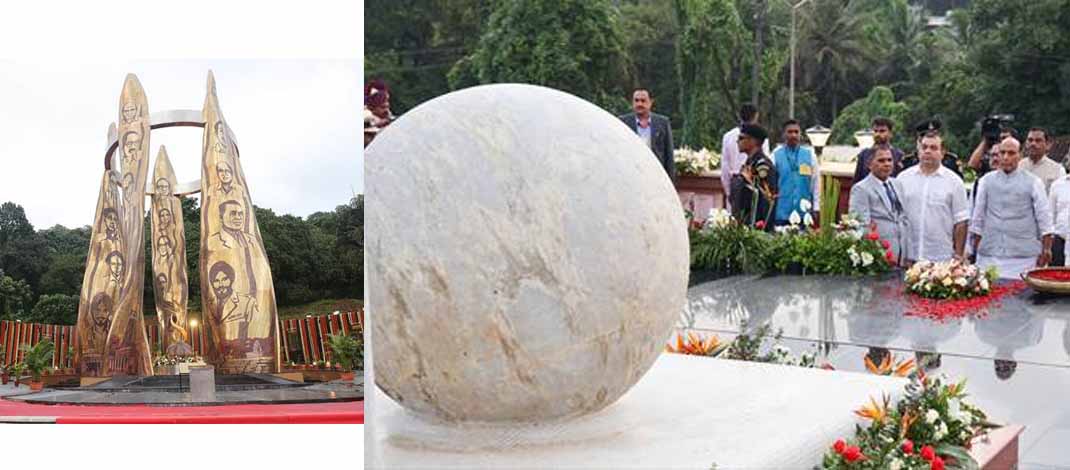
Panaji : Defence Minister Rajnath Singh inaugurated the redeveloped Hutatma Smruti Smarak at Patradevi in Goa on Wednesday. The memorial commemorates the satyagrahis who lost their lives during the movement to end Portuguese rule in Goa.
Goa Chief Minister Pramod Sawant and Union Minister of State for Power and New and Renewable Energy Shripad Y. Naik attended the inauguration. Rajya Sabha MP Sadanand Shet Tanavade, Pernem MLA Pravin Arlekar, senior state government officials, representatives of the Goa, Daman and Diu Freedom Fighters’ Association, and families of the satyagrahis were also present.
Tribute to Goa’s Liberation Movement
Addressing the gathering, Singh paid tribute to the satyagrahis who participated in the Goa liberation movement, including Karnail Singh of Punjab, Sahodra Devi of Madhya Pradesh and Madhukar Damodar Chaudhary of Maharashtra.
He said the movement should be viewed not only as a regional struggle but also as an expression of India’s national consciousness and unity. Singh emphasised that national unity should take precedence over regionalism, communalism and caste-based divisions.
“Patradevi conveys a powerful message that while India may have diverse regional, social and cultural identities, ‘being Indian’ is what binds us all together,” he said.
The Defence Minister also highlighted the role of peaceful resistance in the liberation movement. He said the satyagrahis had demonstrated that India could assert its rights through non-violent means. At the same time, he said that when the territorial integrity of a sovereign nation is threatened and peaceful efforts have reached their limit, the country has the right to use its full strength.
Reference to Operation Vijay and Operation Sindoor
Singh commended the Indian Armed Forces for the professionalism, courage and discipline displayed during the liberation of Goa in Operation Vijay in 1961. He said the operation had set an example for militaries around the world and established a tradition of confidence and resolve within India’s defence forces.
Referring to Operation Sindoor, he said the operation demonstrated the capability of the armed forces to respond to threats against the country. He described the liberation of Goa as not only an occasion to remember military valour but also a reminder that India’s armed forces must remain vigilant, capable and prepared to protect the country’s sovereignty and territorial integrity.
Defence Production and Exports
Reflecting on India’s transformation since 1961, Singh highlighted developments in the country’s defence capabilities, including warships, fighter aircraft, advanced radar systems, network-centric warfare and long-range air power.
He said the three services were moving towards greater jointness and integration, while the country was also strengthening its domestic defence industrial base.
According to figures cited in his address, India’s defence exports have increased from approximately Rs 600 crore before 2014 to more than Rs 38,000 crore, while defence production has risen from about Rs 40,000 crore to Rs 1.81 lakh crore.
Singh also referred to India’s economic growth, young workforce and expanding defence manufacturing ecosystem. He said the country was working to reduce its dependence on defence imports and emerge as a major global defence manufacturing and exporting nation. He added that the West Asia crisis had affected India’s progress towards becoming the world’s third-largest economy.
Emphasis on Women’s Role
The Defence Minister also referred to the growing participation of women in national development and security. He said women who had once stood at the forefront of India’s freedom struggle were now serving as fighter pilots, military leaders and participants in space missions, while also contributing to innovation and entrepreneurship.
Singh said present and future generations had a responsibility to honour the freedom secured through the sacrifices of freedom fighters. He stressed that freedom involved not only the right to express oneself but also the responsibility to uphold national unity, respect constitutional values, obey the law and place national interests above personal gain.
Memorial Redeveloped as Educational Space
The redevelopment of the Hutatma Smruti Smarak was undertaken by the Government of Goa through the Goa State Infrastructure Development Corporation at an estimated cost of Rs 9.50 crore.
The redeveloped memorial includes a redesigned central monument, sculptural installations, information hubs and murals depicting the history of Goa’s liberation struggle. The site has been developed as an educational and commemorative space, with a particular focus on helping younger visitors understand the sacrifices made during the movement.
Patradevi holds historical significance in Goa’s liberation struggle. On August 15, 1955, thousands of volunteers from different parts of India participated in a peaceful satyagraha. The first group of satyagrahis entered Goa through Patradevi while carrying Indian flags and came under Portuguese machine-gun fire. Several participants were killed at the site, while others lost their lives at different locations during the movement.
Singh said the stories of the martyrs should not remain limited to names and dates in history books. He urged young people visiting Goa to visit the memorial and learn about the lives, courage and sacrifices of those who participated in the struggle.
“A generation that understands its history can steer its future in the right direction,” he said.